Spss Syntax to Read in Correlation Table File
Also run into Pearson Correlations - Quick Introduction.
- Correlation Test - What Is Information technology?
- Null Hypothesis
- Assumptions
- Correlation Test in SPSS
- Reporting
Correlation Examination - What Is It?
A (Pearson) correlation is a number between -ane and +1 that indicates to what extent 2 quantitative variables are linearly related. It'southward best understood past looking at some scatterplots.
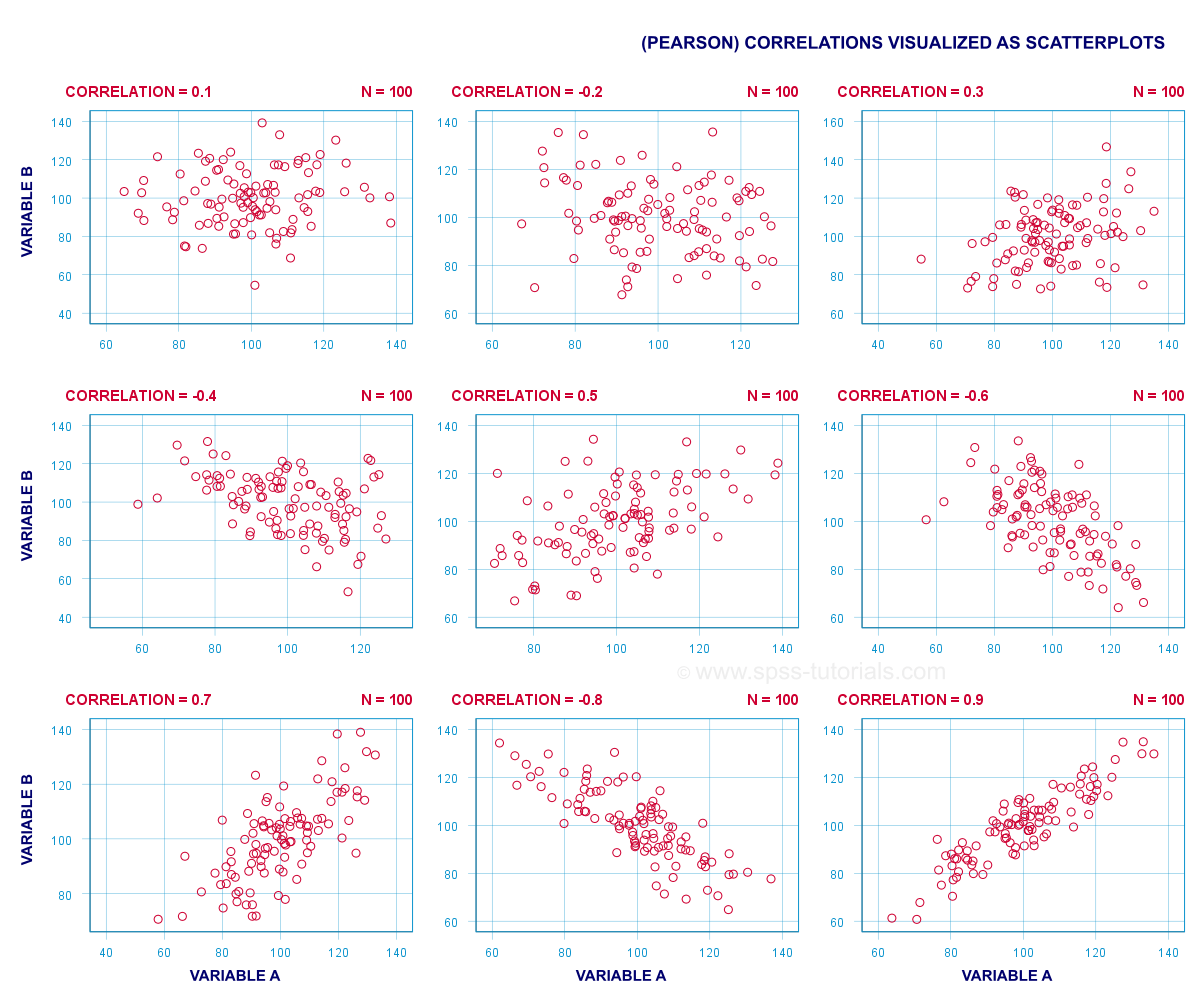
In brusk,
- a correlation of -1 indicates a perfect linear descending relation: college scores on one variable imply lower scores on the other variable.
- a correlation of 0 ways in that location'southward no linear relation betwixt two variables whatsoever. However, there may be a (strong) not-linear relation nevertheless.
- a correlation of 1 indicates a perfect ascending linear relation: higher scores on one variable are associated with higher scores on the other variable.
Nothing Hypothesis
A correlation test (usually) tests the null hypothesis that the population correlation is zero. Data often contain just a sample from a (much) larger population: I surveyed 100 customers (sample) merely I'thou really interested in all my 100,000 customers (population). Sample outcomes typically differ somewhat from population outcomes. So finding a not zero correlation in my sample does not evidence that 2 variables are correlated in my unabridged population; if the population correlation is really cipher, I may hands find a small correlation in my sample. Withal, finding a strong correlation in this case is very unlikely and suggests that my population correlation wasn't aught after all.
Correlation Test - Assumptions
Calculating and interpreting correlation coefficients themselves does not require any assumptions. Still, the statistical significance-test for correlations assumes
- independent observations;
- normality: our 2 variables must follow a bivariate normal distribution in our population. This assumption is not needed for sample sizes of Northward = 25 or more.
SPSS - Quick Data Bank check
Let'south run some correlation tests in SPSS now. We'll use adolescents.sav, a data file which holds psychological test data on 128 children between 12 and xiv years sometime. Office of its variable view is shown below.
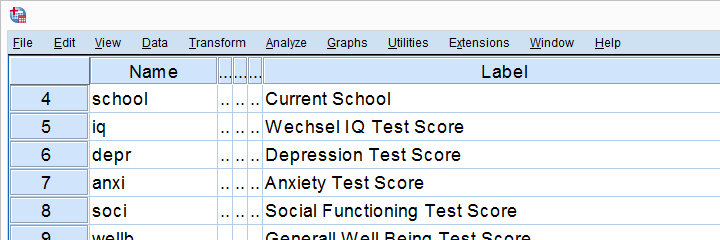
Now, before running any correlations, let's first make sure our data are plausible in the commencement place. Since all v variables are metric, we'll apace inspect their histograms by running the syntax below.
*Quick data check: histograms over all relevant variables.
frequencies iq to wellb
/format notable
/histogram.
Histogram Output
Our histograms tell u.s. a lot: our variables take betwixt v and 10 missing values. Their means are close to 100 with standard deviations around 15 -which is good because that'southward how these tests have been calibrated. One affair bothers me, though, and it's shown below.
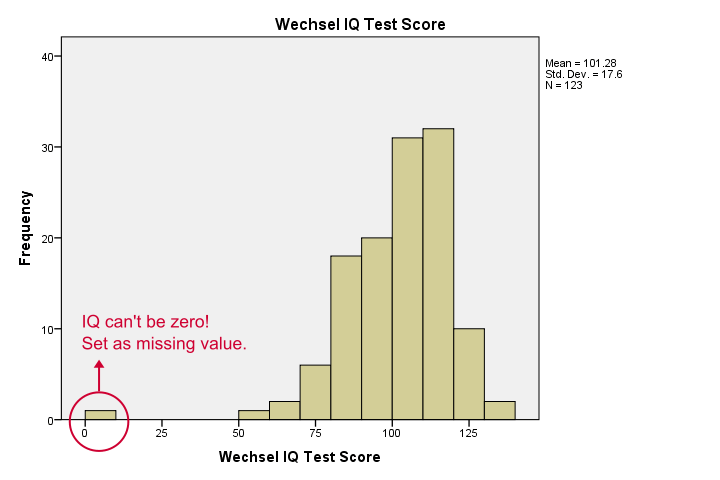
It seems similar somebody scored nothing on some tests -which is not plausible at all. If we ignore this, our correlations will be severely biased. Let'due south sort our cases, see what's going on and set up some missing values earlier proceeding.
*Audit example with low iq / anxi scores.
sort cases by iq.
*One example has zero on both tests. Set as missing value before proceeding.
missing values iq anxi (0).
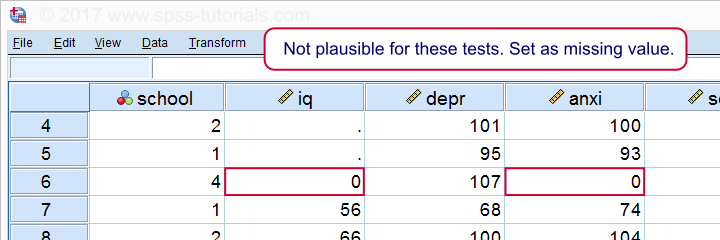
If we now rerun our histograms, we'll meet that all distributions look plausible. Only now should we proceed to running the actual correlations.
Running a Correlation Exam in SPSS
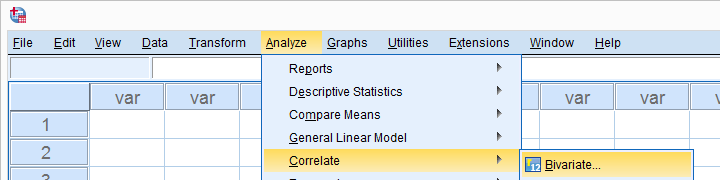
Allow's first navigate to  every bit shown below.
Motion all relevant variables into the variables box. You probably don't desire to alter annihilation else here.
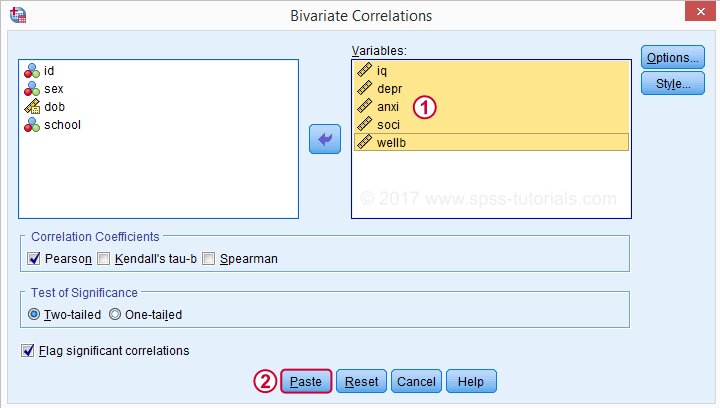
Clicking results in the syntax below. Allow'due south run it.
SPSS CORRELATIONS Syntax
*Correlations as pasted from menu.
CORRELATIONS
/VARIABLES=iq depr anxi soci wellb
/PRINT=TWOTAIL NOSIG
/MISSING=PAIRWISE.
*Shorter version, creates verbal same output.
correlations iq to wellb
/print nosig.
Correlation Output
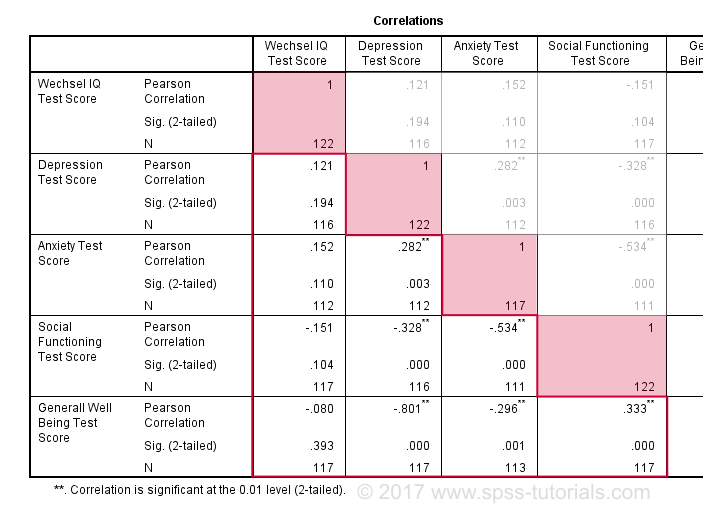
By default, SPSS always creates a full correlation matrix. Each correlation appears twice: above and below the main diagonal. The correlations on the main diagonal are the correlations between each variable and itself -which is why they are all ane and non interesting at all. The 10 correlations below the diagonal are what we demand. Every bit a rule of thumb, a correlation is statistically significant if its "Sig. (two-tailed)" < 0.05. Now allow'south have a shut wait at our results: the strongest correlation is between depression and overall well-existence : r = -0.801. It'south based on N = 117 children and its 2-tailed significance, p = 0.000. This means there's a 0.000 probability of finding this sample correlation -or a larger i- if the actual population correlation is cypher.
Annotation that IQ does not correlate with annihilation. Its strongest correlation is 0.152 with anxiety but p = 0.11 and then information technology's non statistically significantly different from zero. That is, there'south an 0.11 chance of finding it if the population correlation is cypher. This correlation is as well small to pass up the nil hypothesis.
Like so, our 10 correlations bespeak to which extent each pair of variables are linearly related. Finally, note that each correlation is computed on a slightly different N -ranging from 111 to 117. This is because SPSS uses pairwise deletion of missing values by default for correlations.
Scatterplots
Strictly, we should audit all scatterplots amongst our variables likewise. After all, variables that don't correlate could however be related in some non-linear fashion. Merely for more than than five or six variables, the number of possible scatterplots explodes and so we often skip inspecting them. However, see SPSS - Create All Scatterplots Tool.
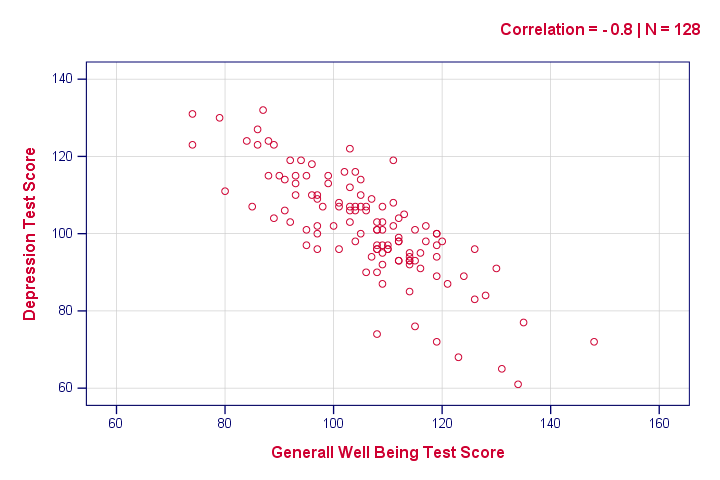
The syntax beneath creates just one scatterplot, just to get an idea of what our relation looks similar. The result doesn't show anything unexpected, though.
*Simple scatterplot for wellbeing by depression.
graph
/scatter wellb with depr
/subtitle "Correlation = - 0.8 | N = 128".
Reporting a Correlation Examination
The figure below shows the almost basic format recommended past the APA for reporting correlations. Importantly, make sure the tabular array indicates which correlations are statistically significant at p < 0.05 and perchance p < 0.01. Also see SPSS Correlations in APA Format.
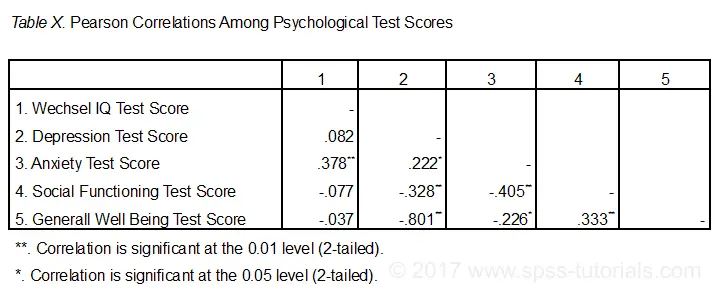
If possible, study the confidence intervals for your correlations as well. Oddly, SPSS doesn't include those. All the same, see SPSS Conviction Intervals for Correlations Tool.
Cheers for reading!
Source: https://www.spss-tutorials.com/spss-correlation-analysis/
0 Response to "Spss Syntax to Read in Correlation Table File"
Post a Comment