Leaving but Seeing Again Quotes Letter Drawings of and
Open Volume: To The Letter, past Simon Garfield
The turn down of the epistolary art form

Reviews and recommendations are unbiased and products are independently selected. Postmedia may earn an affiliate commission from purchases made through links on this page.
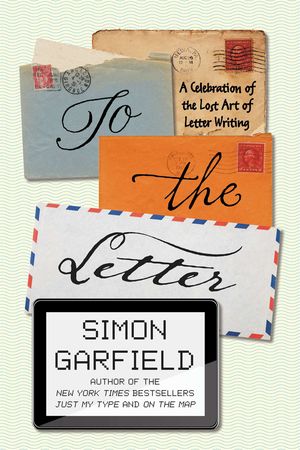 The future of letters looks bleak, Simon Garfield laments at the determination of To The Alphabetic character: A Commemoration of the Lost Art of Alphabetic character Writing. It's hard not to blame electronic mail, that intrusive medium. "Emails are a poke, but letters are a caress," Garfield writes. We alive in a culture where our nervous systems suffer far more pokes than caresses.
Oddly enough, in this history of letter writing, one of the striking episodes is precisely the invention of email. It began in 1969, when computer scientists attempted to accept two computers, nigh the size of refrigerators, 350 miles apart, communicate with each other. The results were not spectacular, although computers did manage to transmit and recognize two messages of the alphabet, L and O. "And that was when letter writing began its slow demise," Garfield writes.
E-mail may represent the triumph of the digital, but it even so betrays curious affinities with written linguistic communication and literate culture. A estimator wizard, Ray Tomlinson, is historic past Garfield for finding a new utilize for an old sign, @.
"Tomlinson says he but grabbed information technology off the keyboard because it wasn't much used for anything else, and it before long became a universal mode of separating personal and local emails from global ones in a mailing address," Garfield writes. "40 years on, emails yet desire to be more similar letters." Screen iconography is often derived from the office — the office that once was hailed as "paperless" — with paper clips to denote attachments and wastepaper baskets to denote trash.
Just equally middle class people purchased manuals on how to write messages in the 18th century, so their descendants purchased email writing manuals, such as a Penguin guide from 2005. This useful volume offered concise tips: "Continue your attachments short; never ship an empty message; never attach sound effects." Some advice revealed the deviation between literate and digital cultures. In written messages, for case, a writer is supposed to employ exclamation marks very sparingly. Garfield, nevertheless, quotes the authors of a 2007 manual entitled Ship: the How, Why, When — and When Non — of E-mail: "Because email is without touch, it has a dulling quality that virtually necessitates kicking everything up a notch just to bring it to where information technology would normally be." To say but "thanks" is fine in a written letter — in an email message information technology can sound almost sarcastic. Similarly, to write "thanks!!!" in a letter sounds excessive; in an e-mail it may be perfectly fitting.
Our unconscious habits are affected by other differences betwixt the use of email and the written letter. Emails well-nigh demand a prompt response, so that exchanges tin starting time to pile up in a single day. In a written correspondence, however, there is plenty of time to reverberate on the final letter of the alphabet received.
Progress marches on regardless. In 1995, Garfield observes, the number of electronic mail messages sent in the United States surpassed the amount of paper mail delivered by the Postal service Office. Now electronic mail itself is threatened with obsolescence, overshadowed past fifty-fifty greater demands for brevity and quick response from tweets and instant messaging. Predictions of the demise of letter writing can only be dire. Still, as Garfield points out, laments over the reject of letter writing are non new, and are belied by the presence in our lifetimes of great letter writers such as the late poet Ted Hughes.
I am myself intrigued with the electric current publication of the letters of T.S. Eliot, a dull, multi-book projection — each book near a thousand pages — that threatens to overwhelm bookshelves everywhere. The latest one, Volume IV, covers one year in the life of Eliot, from 1928 to 1929, leaving some other 35 years before his death.
Simply Hughes and Eliot were basically innocent of the telephone and calculator. I have problem imagining people deciding to ring upward Tom Eliot out of the bluish. Such letter writers we will never have once more.
In the long run, of course, if engineering science has macerated letter writing it has also enabled it. Garfield begins his history of the genre with a description of a cache of letters written on wooden tablets found in what was once Roman Britain. The content of these letters is ageless in its politeness — wishes for the proficient wellness of the recipient, and so on — but the primitive medium works against any flights of emotion or philosophy. Those flights, along with a sense of individuality and intimacy, were reserved for letters written in papyrus, by masters of the grade such as the statesman Cicero. His reflections remain sharp afterwards all these centuries. Concerning the wild beast hunt in the loonshit, Cicero writes a friend, "What pleasure tin it be to a man of refinement, when either a weak man is torn by an extremely powerful animate being, or a excellent fauna is transfixed past a hunting spear?"
Less the sage and more than the raconteur was the equally bully alphabetic character writer, Pliny the Younger, writing in what Garfield calls a "natural, easy and expressive style." His letter writing, along with Cicero'due south, weathered the barbarian invasions and a 1000-yr period in which letters pretty well dealt with matters doctrinal and ecclesiastical. "You may prefer expiry to the lingering torture of reading them," writes Garfield, no fan of moral or theological betterment in his letter reading. In the waning Heart Ages relief appeared in the course of Petrarch, a poet and letter of the alphabet writer with a strong merits, Garfield notes, to being the globe's offset tourist. "He travels to Paris, the Low Countries and the Rhone, he climbs mountains and he reports dorsum," Garfield writes. "The only thing that prevents him travelling further — to Jerusalem, for instance — is his terrible seasickness."
Early on 19th century Britain produced two literary geniuses with very different epistolary styles. The letters of Jane Austen, whose characters wrote some stinging examples of the art, rank amidst the greatest disappointments in literature. "It is startling to discover how damn tiresome so many of Austen's own messages are," Garfield writes. "Y'all can read a bang-up many pages without finding whatever insight into their writer, or even much to amuse or inform." But then Jane Austen was very much aware that her letters would be passed around and read out loud past family members.
John Keats had no such inhibiting occasions. His letters, mingling emotion and intellect, Garfield writes, "are all that Jane Austen'south are not." His letters to his fiancé Fanny Brawne in detail are one of the world'south foremost examples of that sub-genre, the love letter — may it never be tweeted or facebook'd out of existence. A serial of love letters are interspersed throughout Garfield'due south narrative, written by a Chris Barker, a British serviceman stationed in Africa and Greece during the Second Globe State of war, to his sweetheart dorsum home, Bessie Moore. Equally the war grinds on, Barker, a virgin, becomes more than fervent in his thwarted sexual longings. "How tin I tell you lot I want to implant myself," he writes to Moore, "how my lips need to meet your flesh everywhere, to kiss your hair, your ears, your lips, to kiss your breasts; to kiss you lot, to put my confront between your legs, in homage, in beloved, in obedience."
This is a different kind of phonation represented in Garfield's volume — not the voice of literary talent but the vocalisation of decent, intelligent, well educated correspondents, expressing their yearnings in highly stressful circumstances. At a glance, the Barker/Moore correspondence reminds the reader of the American journalist Mignon McLaughlin's remark that "If you must re-read old dearest messages, better choice a room without mirrors." Barker may well have re-read his one-time dear letters and squirmed at the epitome of the fellow he once was.
But as information technology happens we know how the beloved affair turned out, later on the lovers were reunited and costless to express themselves in person. This re-union was not perfect rapture — but the couple did have a happy marriage. This noesis adds to the depth of our appreciation of their irony-free advice. It also reinforces our appreciation of the letters themselves, and our agreement with Garfield that "the decline and abandonment of letters — the price of progress — will be an immeasurable defeat."

Source: https://nationalpost.com/entertainment/books/book-reviews/open-book-to-the-letter-by-simon-garfield
0 Response to "Leaving but Seeing Again Quotes Letter Drawings of and"
Post a Comment